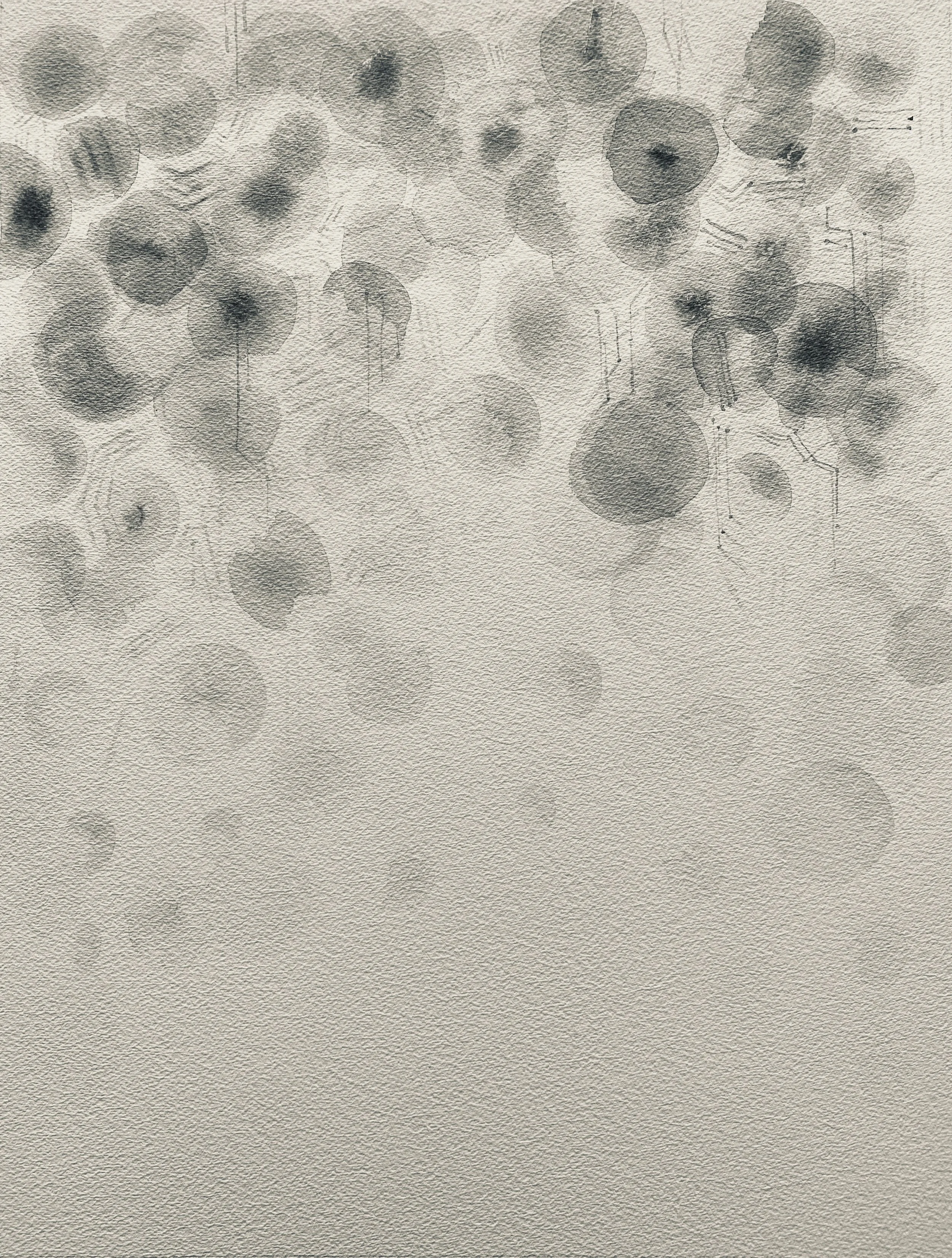
Fig. 1
Watercolour on paper (archival watercolour on Arches 850 gsm paper)
76 × 56 cm, unframed
Video loop, 1 min 20 sec, with sound
Quieting 2026
Quieting comprises a watercolour painting on paper and a moving image with sound, presented as two states of a single work.
The work develops through repeated translation between painting and artificial intelligence. Through this process, the artificial is used to intensify the experience of the real, creating the conditions for a shared perceptual state.
It begins with a single hand-painted watercolour on paper. Chosen for its simplicity and material sensitivity, watercolour allows pigment to move in response to water, gravity, and time, forming an unstable field. This establishes an underlying structure — its density, behaviour, and internal logic — which remains active as the work unfolds.
Artificial intelligence does not generate the moving images independently, but responds to the material conditions of the painting — density, edge, paper, and mark — directed by the artist to extend the gestures of the painting into moving states that coexist with remembered moments of quiet contemplation and attention to process. The painting acts as a type of seed, carrying both organic and non-organic signals that allow the AI to register gradients, transparencies, and linear structures. The process is iterative, with each stage selected, edited, and refined in relation to the original painting.
The work passes through states of descent, absorption, ignition, expansion, compression, and dissolution — shifting conditions rather than fixed forms. Subtle traces of natural phenomena — fire, rain, ocean — emerge and recede, not as representations but as perceptual echoes. Sound works in parallel with the visual, subtly drawing the viewer into a sustained condition of attention.
As the work moves between painting, AI, and video, the material form changes. What persists is a shared perceptual condition — emerging through attention rather than contained within the work. Presented together, the painting and moving image allow the viewer to register how perception shifts through translation, across medium.
The work remains perceptually open, where forms suggest recognition but do not resolve. Attention is held rather than directed, allowing experience to settle and quieten. In moving between the painting and the video, the viewer is invited to form connections at the level of feeling, where the work ultimately unfolds through experience itself.